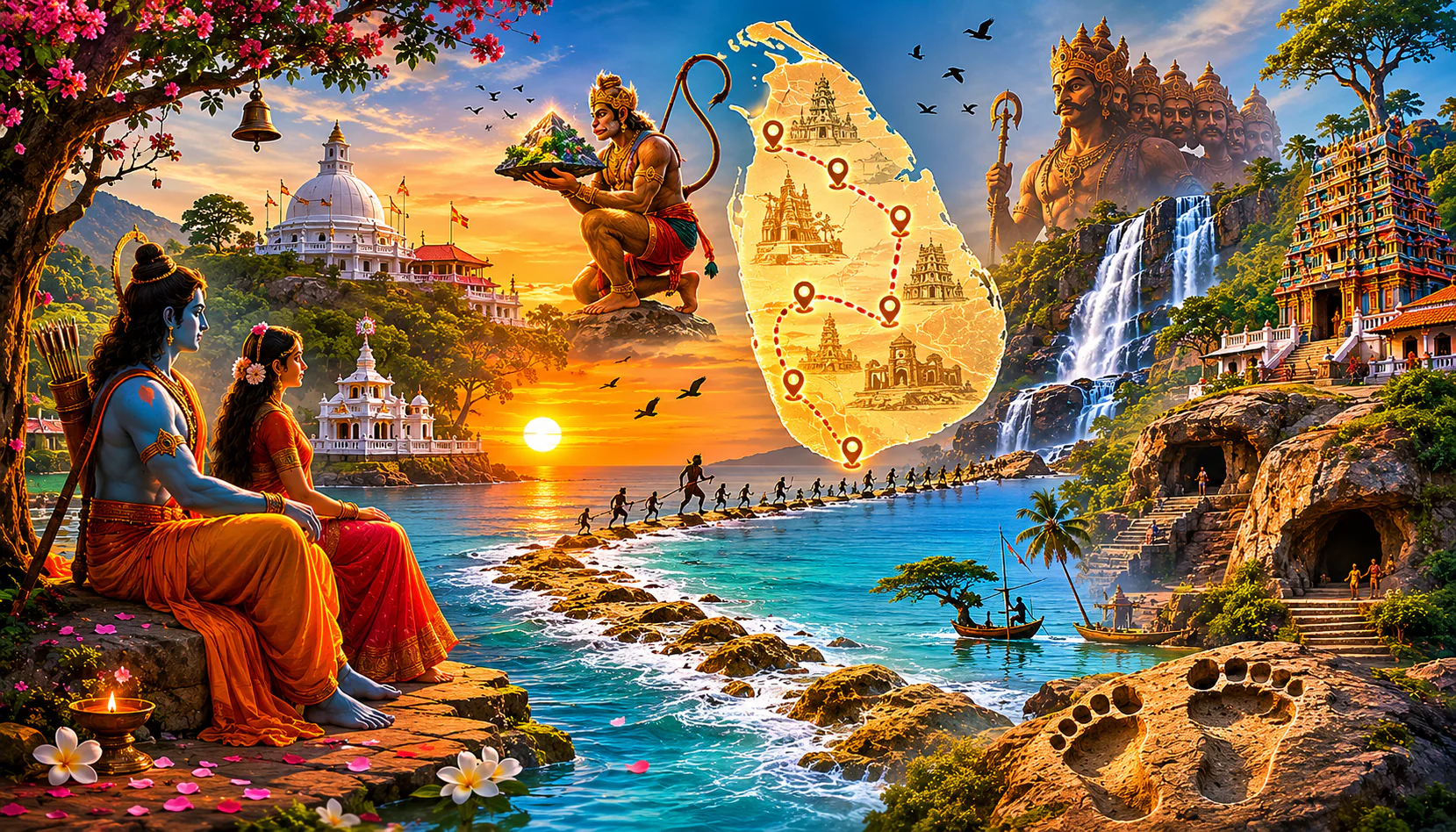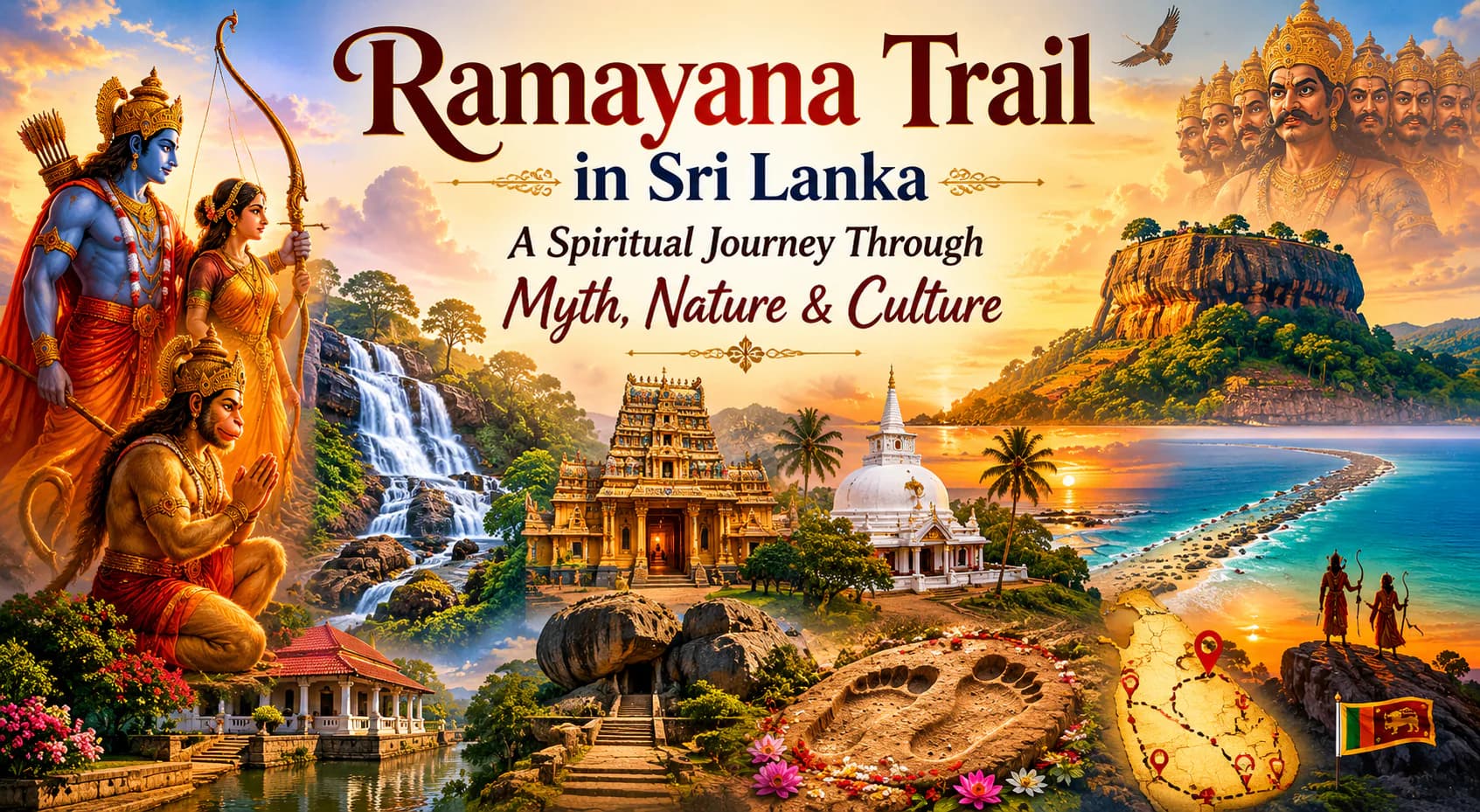
Ramayana Trail in Sri Lanka: A Spiritual Journey Through Myth, Nature & Culture
Explore the Ramayana Trail in Sri Lanka with sacred temples, legendary caves, waterfalls, Ashok
Vatika, Seetha Amman Temple, Ravana Falls, Divurumpola, Ram Setu, and meaningful spiritual
travel experiences.
Sri Lanka is a small island, but for travelers who love culture, mythology, spirituality, and ancient
stories, it feels like a living storybook. Among the many travel experiences in Sri Lanka, the
Ramayana Trail is one of the most unique. It takes visitors through temples, waterfalls, caves,
hill country landscapes, coastal shrines, sacred places, and locations connected with the great
Hindu epic, the Ramayana.
For many Indian travelers and Hindu devotees, this journey is more than sightseeing. It is a
spiritual path that follows the story of Lord Rama, Goddess Sita, Lord Hanuman, and King
Ravana. For other travelers, it is a beautiful cultural route that combines mythology, nature,
local beliefs, and Sri Lankan folklore.
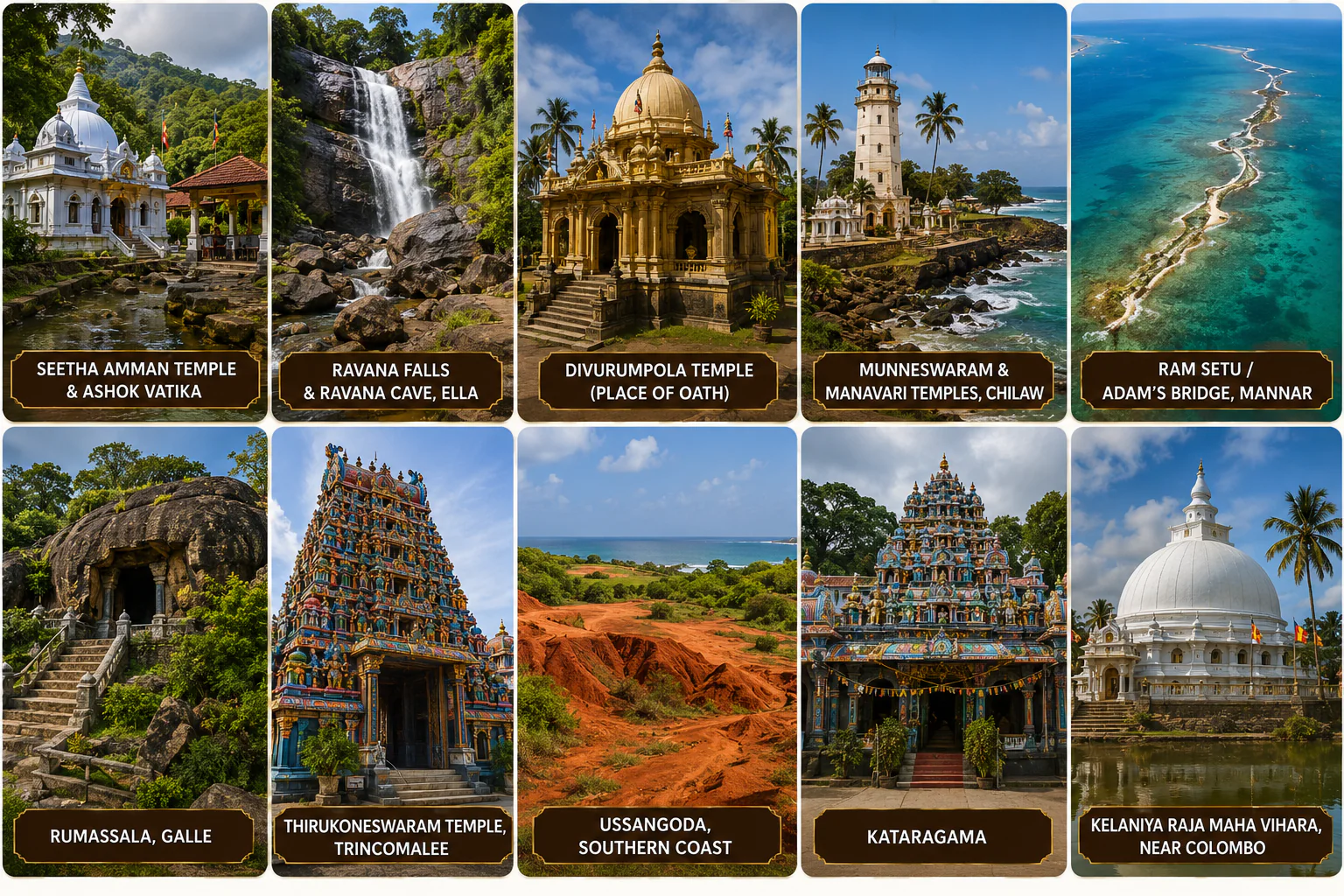
The Ramayana Trail in Sri Lanka includes many locations traditionally connected to the epic.
Some are temples, some are natural landmarks, and some are places where local communities
have preserved stories for generations. While these places are deeply meaningful to devotees, it
is important to understand that many of the stories are based on belief, mythology, and local
tradition rather than fully confirmed archaeological evidence. Your uploaded document also
mentions major Ramayana-related places such as Seetha Amman Temple, Ravana Falls, Ravana
Cave, Divurumpola, Munneswaram, Manavari, Ram Setu / Adam’s Bridge, Rumassala,
Thirukoneswaram, Ussangoda, Kataragama, and Kelaniya.
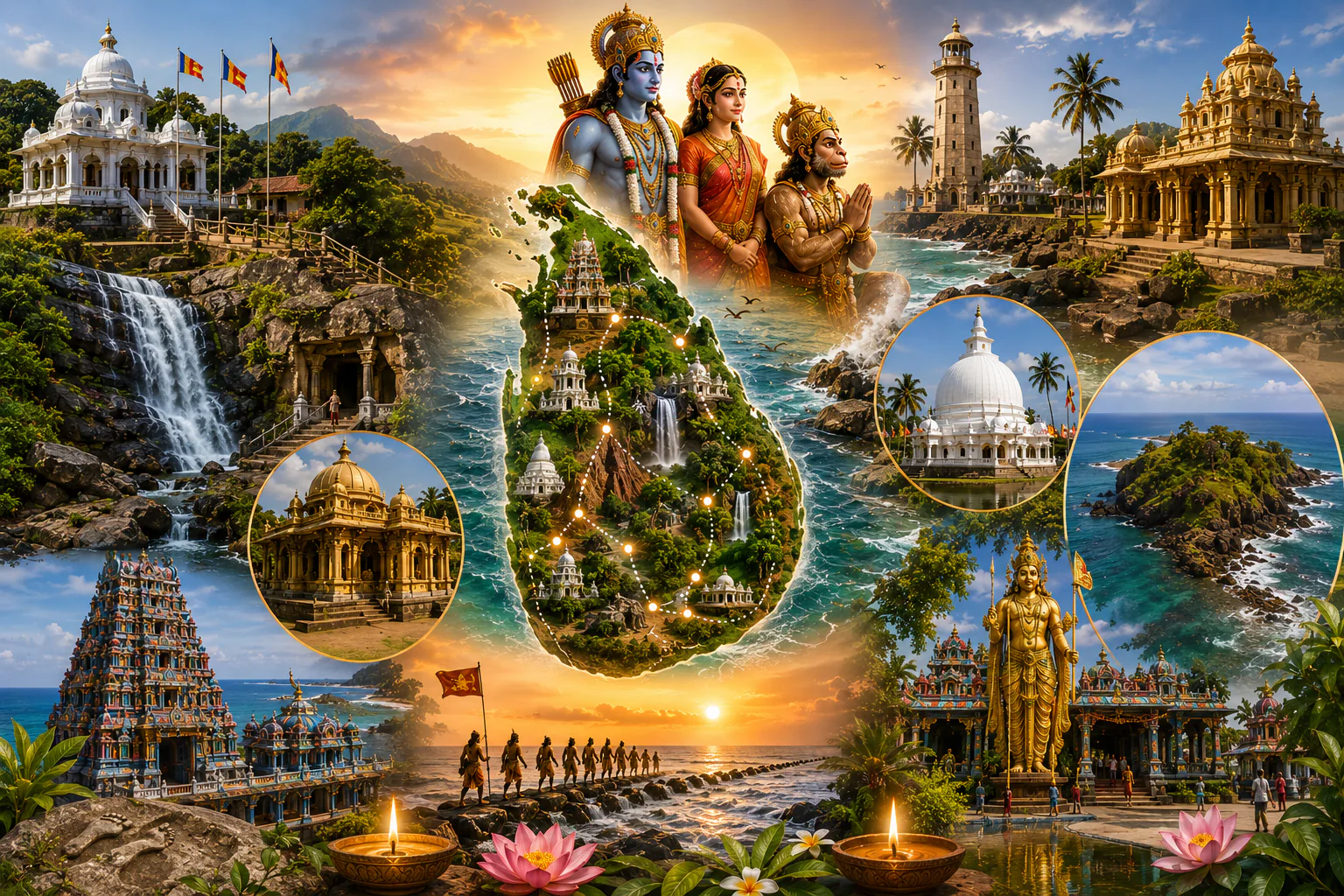
Why Sri Lanka Is Important in the Ramayana Story
In the Ramayana, Lanka is described as the kingdom of King Ravana. According to the epic,
Ravana brought Goddess Sita to Lanka after abducting her, and Lord Rama later crossed the
ocean with the help of Hanuman and the Vanara army to rescue her.
Today, many places in Sri Lanka are believed to be connected with these events. Travelers can
visit hill country temples, ancient kovils, waterfalls, caves, coastal sites, and sacred places that
are linked to different chapters of the Ramayana story. Sri Lanka is often promoted as home to
more than 50 Ramayana-related sites, although most tours cover the most accessible and
important locations.
Seetha Amman Temple and Ashok Vatika
One of the most important places on the Ramayana Trail is Seetha Amman Temple in Seetha
Eliya, near Nuwara Eliya. This temple is traditionally believed to be connected to Ashok Vatika,
the garden where Goddess Sita was kept by King Ravana.
The area feels peaceful and spiritual. A small stream flows near the temple, and many devotees
believe this is where Sita used to bathe. There are also rock marks nearby that local tradition
connects with Lord Hanuman’s footprints.
For travelers, this site is special because it combines devotion, natural beauty, and hill country
scenery. The cool climate of Nuwara Eliya, misty hills, tea plantations, and calm surroundings
make the visit even more memorable.
Ravana Falls and Ravana Cave in Ella
Ella is one of Sri Lanka’s most beautiful hill country destinations, and it is also strongly
connected with Ramayana legends. Ravana Falls is a famous waterfall near Ella, and Ravana
Cave is located above the area.
According to local belief, Ravana hid Sita in caves around Ella. The waterfall is easy to visit
because it is located close to the main road, while Ravana Cave requires a climb. Travelers
should be careful when visiting the cave because the path can be steep and tiring.
Even for visitors who are not familiar with the Ramayana, this area is worth visiting because of
its mountain views, waterfalls, greenery, and adventurous feeling.0
Divurumpola Temple: The Place of Oath
Divurumpola Temple, near Welimada, is another important Ramayana site. The name
Divurumpola is often explained as “place of oath.” According to tradition, this is the place where
Goddess Sita performed the Agni Pariksha, or trial by fire, to prove her purity after being
rescued.
Today, Divurumpola is visited by pilgrims and cultural travelers. It is a calm and meaningful
place, especially for those who want to understand the emotional and spiritual side of the
Ramayana story.
Munneswaram and Manavari Temples in Chilaw
The Ramayana Trail usually includes the Chilaw area because of two important temples:
Munneswaram Temple and Manavari Temple.
According to belief, Lord Rama prayed to Lord Shiva at Munneswaram after the battle with
Ravana. Manavari Temple is also important because it is believed to be connected with the first
Shiva Lingam installed by Lord Rama in Sri Lanka.
These temples are very important for Hindu devotees and are often included in Ramayana tour
packages, especially for Indian travelers.
Ram Setu / Adam’s Bridge in Mannar
Ram Setu, also known as Adam’s Bridge, is one of the most famous locations connected to the
Ramayana. It is a chain of limestone shoals and sandbanks between Mannar Island in Sri Lanka
and India.
In Hindu tradition, Ram Setu is believed to be the bridge built by Lord Rama’s army to cross into
Lanka. From a scientific and geological point of view, it is commonly described as a natural
formation. Because of this, it is better to write about Ram Setu carefully: it is traditionally
believed to be Rama’s bridge, while geology explains it as a natural chain of shoals and
sandbanks.
Rumassala in Galle
Rumassala, near Galle, is another beautiful place connected to Ramayana folklore. According to
the story, when Lakshmana was injured, Hanuman carried a mountain of healing herbs from the
Himalayas. It is believed that a piece of that mountain fell in Rumassala.
Today, Rumassala is known for its greenery, ocean views, biodiversity, and peaceful atmosphere.
It is a good place to combine Ramayana storytelling with a visit to Galle Fort and the southern
coast.
Thirukoneswaram Temple in Trincomalee
Thirukoneswaram Temple in Trincomalee is a famous Hindu temple located on a dramatic cliff
overlooking the Indian Ocean. It is connected with Lord Shiva worship and is also linked to
Ravana in local tradition.
This temple is one of the most scenic spiritual sites in Sri Lanka. The ocean view, temple
architecture, and religious atmosphere make it a powerful stop on a cultural or Ramayana tour.
Ussangoda and Kataragama
Ussangoda, on the southern coast, is linked to the story of Hanuman setting parts of Lanka on
fire. The unusual red soil and open landscape make the place visually different from many other
parts of Sri Lanka.
Kataragama is another important spiritual destination. It is sacred to Buddhists, Hindus,
Muslims, and local devotees. In Ramayana-related travel, it is often included because of its
connection with God Skanda / Lord Murugan and Sri Lankan spiritual traditions.
Kelaniya Raja Maha Vihara
Near Colombo, Kelaniya Raja Maha Vihara is also linked with Ramayana tradition. It is believed
that Vibhishana, Ravana’s brother, was crowned king after Ravana’s defeat.
Kelaniya is also an important Buddhist temple, so it gives travelers a good example of Sri Lanka’s
shared religious and cultural landscape. Because it is close to Colombo, many Ramayana
itineraries include this site near the end of the tour.
Best Ramayana Trail Itinerary in Sri Lanka
A comfortable Ramayana Trail tour usually takes 7 to 8 days. This gives travelers enough time to
visit the main sites without rushing. A good route can include Chilaw, Trincomalee, Kandy,
Nuwara Eliya, Ella, Kataragama, Galle, Colombo, and Kelaniya.
A simple itinerary can start from Bandaranaike International Airport and continue to Chilaw to
visit Munneswaram and Manavari Temples. From there, travelers can continue to Trincomalee
for Thirukoneswaram Temple, then travel inland to Kandy and Ramboda to visit Sri Bhaktha
Hanuman Temple. The journey can then continue to Nuwara Eliya for Seetha Amman Temple
and Ashok Vatika, followed by Ella for Ravana Falls and Ravana Cave.
After the hill country, travelers can move towards Kataragama, Ussangoda, Rumassala, Galle,
and Colombo. The tour can end with Kelaniya Raja Maha Vihara and final Colombo sightseeing
or shopping before departure.
Best Time to Visit the Ramayana Trail
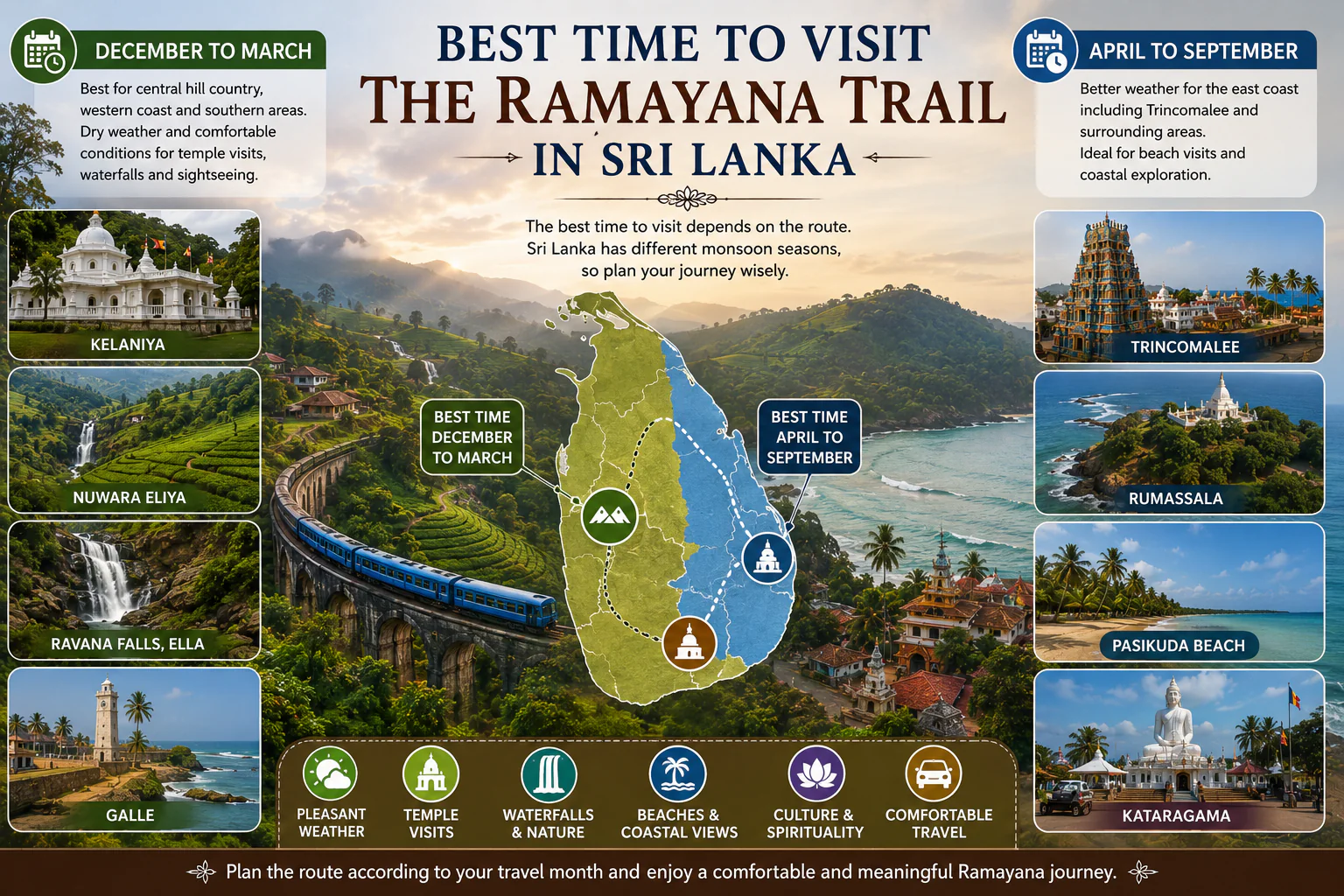
The Ramayana Trail can be visited throughout the year, but the best time depends on the route.
Many popular sites are in the central hill country, western coast, and southern areas. For these
regions, December to March is usually a good period because the weather is drier and more
comfortable for temple visits, waterfalls, and hill country travel.
If the tour includes Trincomalee and the east coast, the weather can be better from around
April to September. Because Sri Lanka has different monsoon seasons, a travel company should
plan the route carefully based on the travel month.
Is the Ramayana Trail Suitable for Families?
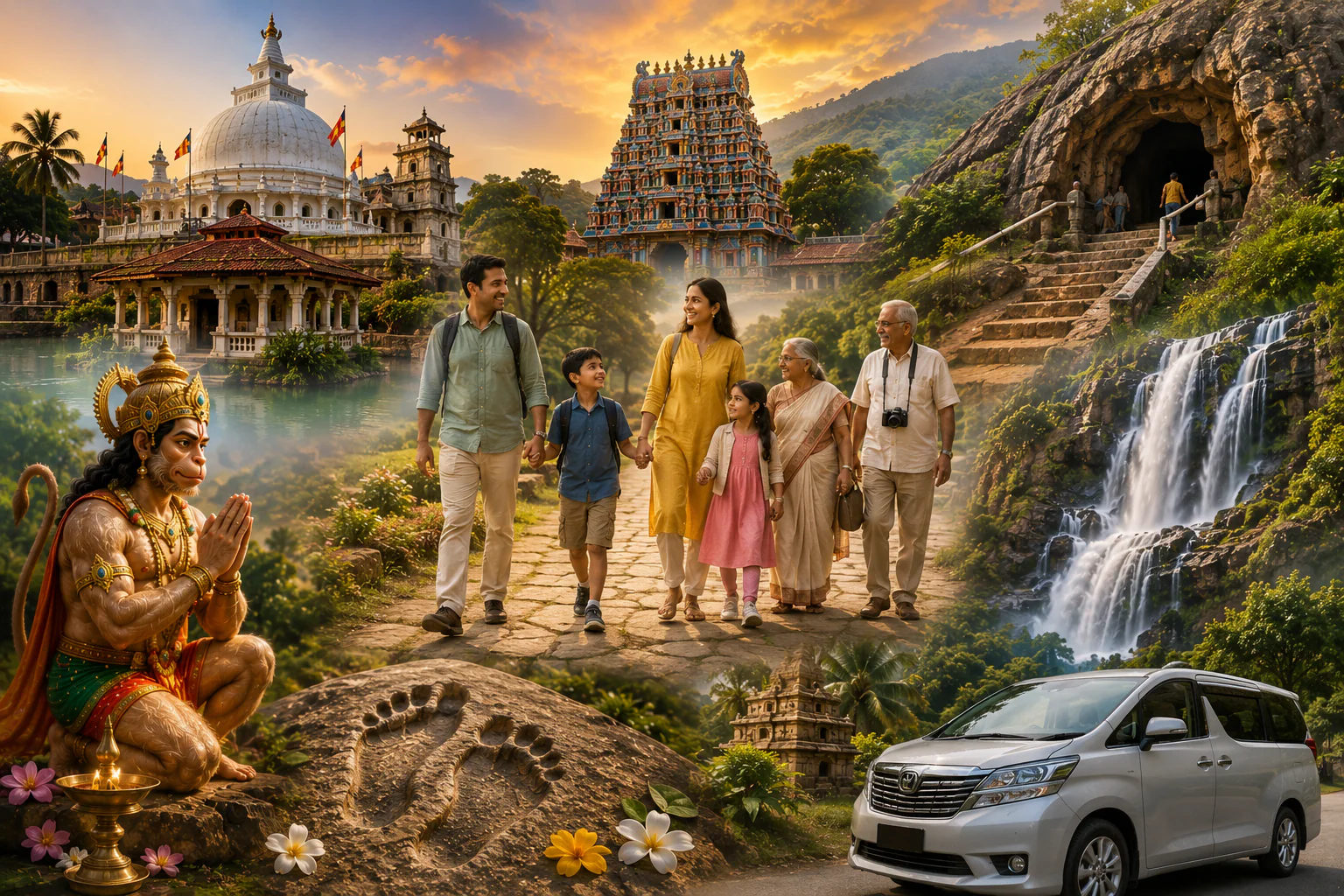
Yes, the Ramayana Trail is suitable for families, especially for travelers interested in culture,
religion, nature, and storytelling. Elderly travelers and children can comfortably visit temples,
waterfalls, and gardens if the itinerary is planned at a relaxed pace.
However, some places like Ravana Cave require climbing and may not be suitable for elderly
travelers, small children, or anyone with knee or walking difficulties. A private vehicle with an
English-speaking driver-guide is recommended for comfort.
Important Travel Tips for Ramayana Pilgrims
Travelers should dress respectfully when visiting temples. Shoulders and knees should be
covered, and shoes must be removed before entering sacred areas. It is also better to carry
socks because temple floors can become hot during the day.
Travelers should also carry drinking water, light clothing, a shawl, sunscreen, and comfortable
walking shoes. For hill country places like Nuwara Eliya and Ella, a light jacket is useful because
the weather can be cool.
Photography is allowed in many places, but visitors should always ask before taking photos
inside temples or near religious rituals.
Common Questions About the Ramayana Trail in Sri Lanka
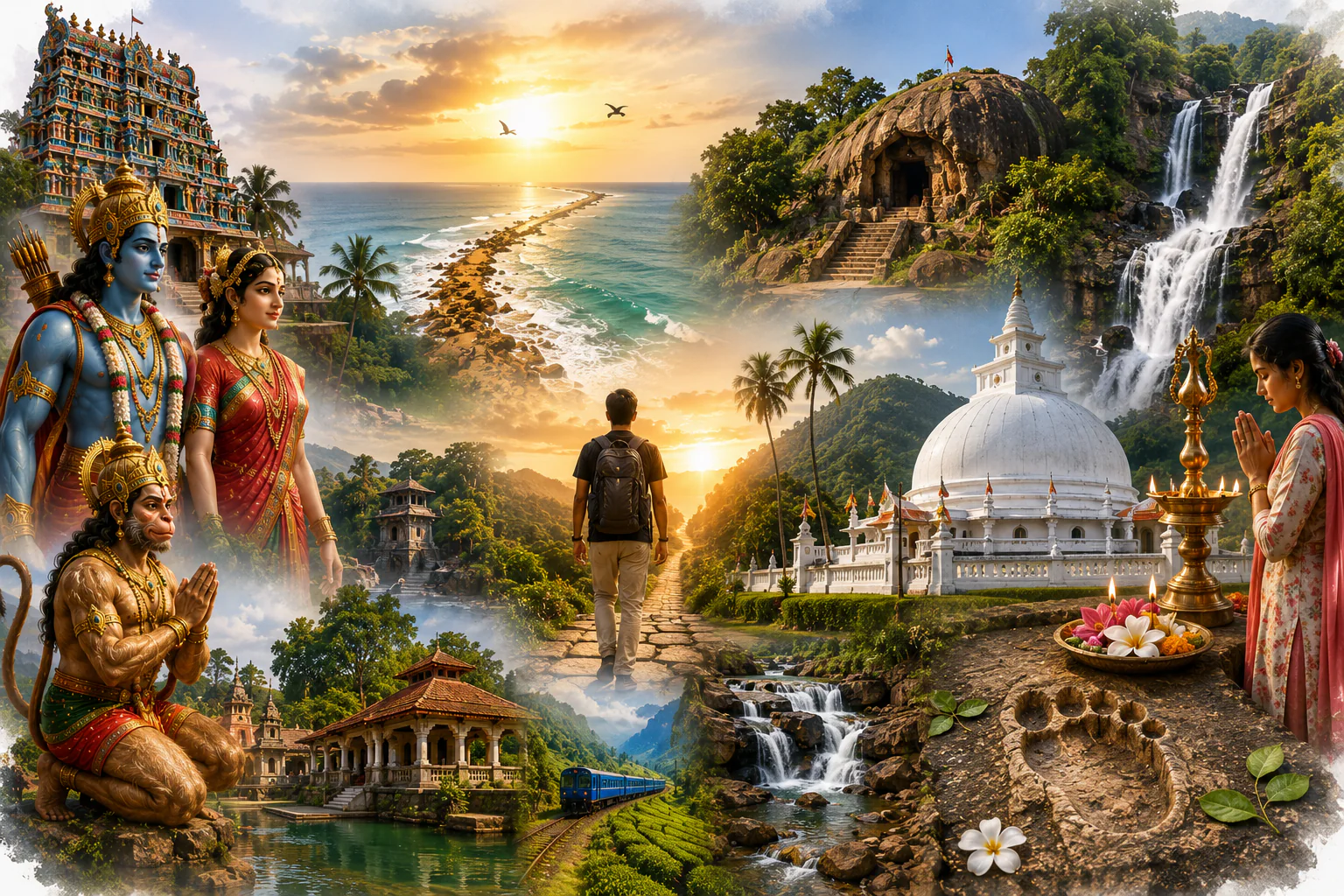
Many travelers first ask, what is the Ramayana Trail in Sri Lanka? The Ramayana Trail is a
spiritual and cultural travel route connected with places mentioned in the Ramayana story. It
includes temples, caves, waterfalls, gardens, coastal sites, and sacred places linked with Lord
Rama, Goddess Sita, Lord Hanuman, and King Ravana. Many travelers visit the Ramayana Trail as
a pilgrimage, while others explore it as a cultural and mythological journey. The route is
especially popular among Indian travelers and Hindu devotees who want to experience the Sri
Lankan locations traditionally connected with the epic.
Another common question is, how many days are needed for a Ramayana tour in Sri Lanka? A
good Ramayana tour in Sri Lanka usually takes around 7 to 8 days. This gives travelers enough
time to visit major places such as Chilaw, Trincomalee, Kandy, Nuwara Eliya, Ella, Kataragama,
Galle, and Colombo without rushing. Shorter tours of 4 to 5 days are possible, but they may only
cover selected highlights like Seetha Amman Temple, Ravana Falls, Divurumpola,
Munneswaram, Manavari, and Kelaniya. For a complete and comfortable experience, a 7-night
or 8-day itinerary is better.
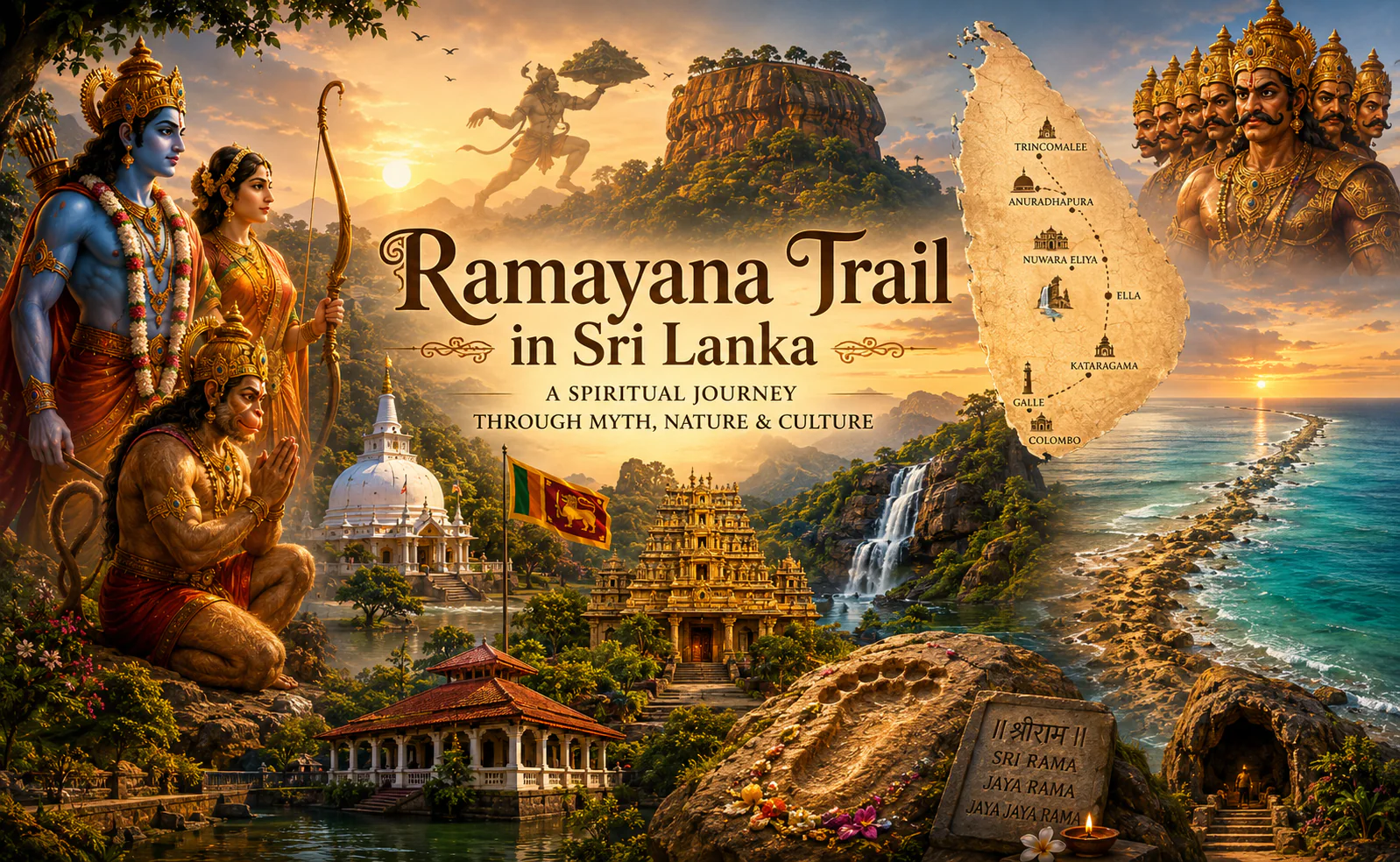
Travelers also ask, what are the most important Ramayana sites in Sri Lanka? The most
important Ramayana sites include Seetha Amman Temple, Ashok Vatika, Ravana Falls, Ravana
Cave, Divurumpola Temple, Munneswaram Temple, Manavari Temple, Ram Setu / Adam’s
Bridge, Rumassala, Thirukoneswaram Temple, Ussangoda, Kataragama, and Kelaniya Raja Maha
Vihara. Each place is connected to a different part of the Ramayana story. Some sites are
important for devotion, some for local folklore, and some for their natural beauty and cultural
value.
Many people also want to know, is there archaeological proof for Ramayana places in Sri
Lanka? There is no complete archaeological proof confirming all Ramayana events in Sri Lanka
as historical facts. Many sites are based on religious belief, mythology, folklore, and traditional
stories passed down through generations. That does not reduce their cultural or spiritual value.
For devotees, these places are sacred. For travelers, they offer a meaningful journey through Sri
Lanka’s mythology, temples, landscapes, and living traditions.
For Indian travelers, another important question is, is the Ramayana Trail suitable for Indian
tourists? Yes, the Ramayana Trail is very suitable for Indian tourists. Many Indian travelers visit
Sri Lanka to explore places connected with Lord Rama, Goddess Sita, Hanuman, and Ravana.
The route is especially meaningful for families, religious groups, senior travelers, and cultural
tourists. Indian travelers can book private Ramayana tour packages with hotel accommodation,
airport transfers, English-speaking driver-guides, temple visits, and sightseeing. It is always
better to check current visa rules before travel.
Travelers often ask, what is the best time to visit Ramayana sites in Sri Lanka? The best time to
visit many Ramayana sites in Sri Lanka is usually from December to March, especially for routes
covering Colombo, Chilaw, Kandy, Nuwara Eliya, Ella, Galle, and the southern coast. The weather
is generally better for sightseeing and outdoor visits during this period. If the itinerary includes
Trincomalee and the east coast, April to September can also be a good travel period. Since Sri
Lanka has different weather patterns in different regions, the best route should be planned
according to the travel month.
Another useful question is, can families and elderly travelers do the Ramayana Trail? Yes,
families and elderly travelers can enjoy the Ramayana Trail if the itinerary is planned properly.
Most temples, gardens, waterfalls, and cultural sites can be visited comfortably by private
vehicle. However, some places such as Ravana Cave involve climbing and may not be suitable for
elderly travelers or small children. A relaxed itinerary with enough rest time, comfortable hotels,
and a private driver-guide is recommended.
Finally, many travelers ask, why should travelers book a Ramayana tour in Sri Lanka? Travelers
should book a Ramayana tour in Sri Lanka because it combines spirituality, mythology, culture,
nature, and beautiful landscapes in one journey. The route takes visitors from coastal temples to
misty tea country, sacred shrines, waterfalls, caves, and historic cities. It is not only a religious
tour. It is also a meaningful travel experience that helps visitors understand Sri Lanka’s
connection with one of Asia’s greatest epics. For devotees, it is a pilgrimage. For culture lovers,
it is a journey through story, belief, and beauty.
Conclusion
The Ramayana Trail in Sri Lanka is one of the most meaningful cultural and spiritual journeys on
the island. It brings together sacred temples, legendary waterfalls, mysterious caves, peaceful
gardens, coastal shrines, and beautiful landscapes connected with one of Asia’s greatest epics.
For Hindu devotees, this journey is a pilgrimage filled with faith and emotion. For cultural
travelers, it is a chance to understand how mythology, folklore, religion, and nature come
together in Sri Lanka. From Seetha Amman Temple in Nuwara Eliya to Ravana Falls in Ella, from
Munneswaram in Chilaw to Rumassala in Galle, every stop tells a story.
The most important thing is to travel with respect and an open heart. These places may be
understood differently by devotees, historians, and travelers, but their cultural and spiritual
value is powerful. A Ramayana tour in Sri Lanka is not only about visiting places. It is about
walking through a story that has lived in people’s hearts for generations.